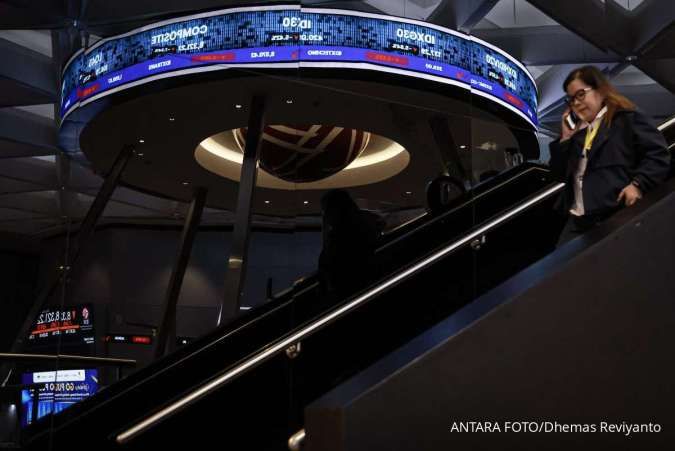
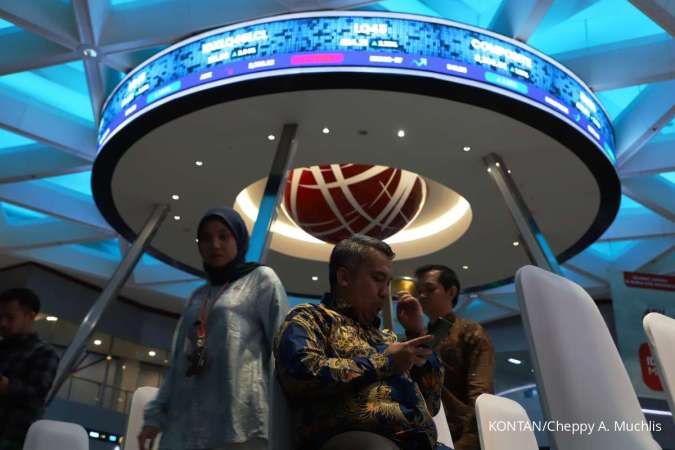
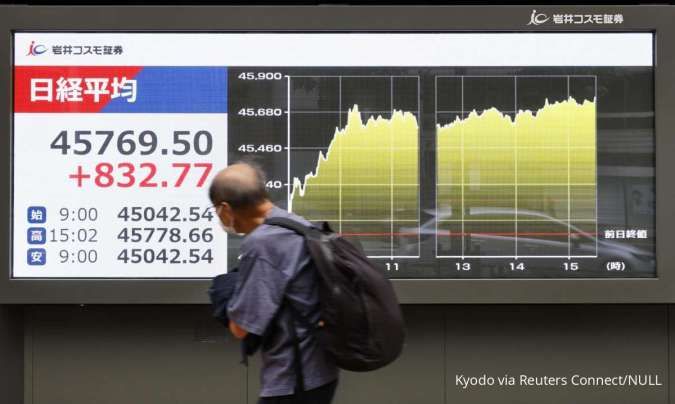
KONTAN.CO.ID - JAKARTA. Indonesian stocks staged a modest recovery on Thursday as the country's regulators unveiled several measures to allay investor fears after a deep rout triggered by the risk of a downgrade to frontier market status sapped already fragile sentiment. Authorities in Southeast Asia's largest economy sought to address concerns raised by index provider MSCI, with Indonesia's financial regulator indicating it would double the free-float requirement for listed firms to 15% as part of its response. The benchmark Jakarta Composite Index cut losses to trade down 1.7% from an earlier slide of 8% - which triggered a trading halt - following Wednesday 7.4% tumble.
Baca Juga: Indonesian Stocks Tank as Downgrade Risk Sets Off Rush for Exits The rupiah was 0.4% softer at 16,770 against the dollar, just below last week's record low of 16,985. Speaking at a press conference, Mahendra Siregar, head of the Financial Services Authority, said communication with MSCI had been positive and it was awaiting a response to its proposed measures, which he hoped could be implemented soon with the issues resolved by March. "This is an ongoing process, not a single announcement," said Mohit Mirpuri, a portfolio manager at SGMC Capital in Singapore. "What investors needed to see was alignment and intent, and that was clearly delivered." "Policy clarity usually comes after volatility, not before it. The last two days of selling have been fairly indiscriminate and historically you don't wait for everything to look perfect before stepping in."
Downgrades After Warning
Investment banks Goldman Sachs and UBS lowered their recommendations for Indonesian stocks a day after MSCI flagged problems with transparency and warned that a downgrade to frontier from emerging status was possible. Such a downgrade by MSCI, one of the biggest providers of market indexes, which are tracked by billions of dollars in passive investments, would force tracking funds to sell. Active managers, whose performance is rated against the benchmarks, would also probably need to sell. MSCI's warning comes as foreign capital has flowed out because of concerns about how President Prabowo Subianto is widening the fiscal deficit and ramping up the state's involvement in financial markets.
Baca Juga: Goldman Sachs Cuts Indonesian Equities Rating after MSCI Flags Investability Risk The appointment of his nephew, Thomas Djiwandono, to the central bank this month, after last year's abrupt sacking of respected Finance Minister Sri Mulyani Indrawati, has shaken confidence in his fiscal stewardship and pushed the rupiah to record lows. "The MSCI warning came at an inopportune time," said Gary Tan, Singapore-based portfolio manager at Allspring Global Investments, pointing to a series of negative macro headlines and a weakening rupiah. "This triggered a typical sell first, ask questions later response from passive and benchmark-driven investors, resulting in a sharp near-term correction," Tan said. He said he was encouraged that regulators have signalled a willingness to engage constructively with MSCI and improve market transparency. Brokerage sources described MSCI's warnings as a "slap in the face" for market authorities, adding that inflows of foreign capital would dry up if MSCI flagged Indonesia as "uninvestable" or non-transparent. Goldman Sachs cut its rating on Indonesian equities to "underweight," warning that outflows of between $2.2 billion and $7.8 billion were possible in the event of an MSCI downgrade, though the strategists said that was unlikely. UBS lowered its rating to "neutral." A downgrade to frontier market status, which analysts so far believe is unlikely, would bring Indonesia on par with Bangladesh, Pakistan, Sri Lanka and Vietnam.
MSCI said it had frozen updates to Indonesian entries in its products while engaging with authorities to resolve "investability risks" over a lack of clarity on stock ownership, trading and price formation in the market. "We expect the market to remain under pressure and do not view this as an entry point," the Goldman strategists said. "Indonesia is facing macro challenges, including soft private consumption, slowing credit growth, and a rising fiscal deficit that is close to the legal 3% of GDP limit." Overseas investors sold 13.96 trillion rupiah ($834 million) worth of Indonesian shares in 2025, the worst year for outflows since 2020, with the selloff continuing in January, LSEG data showed.