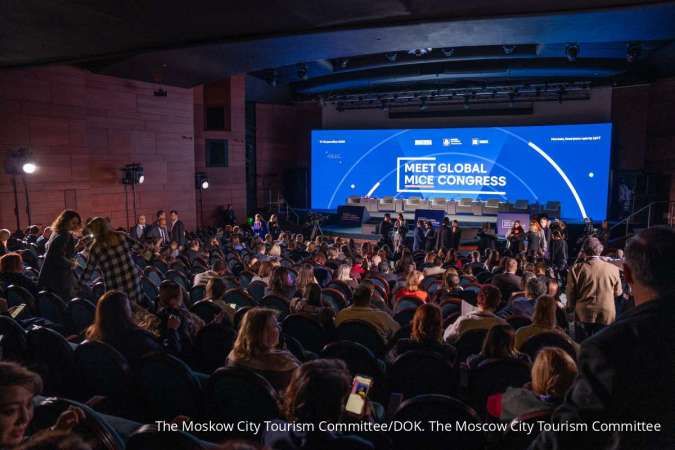
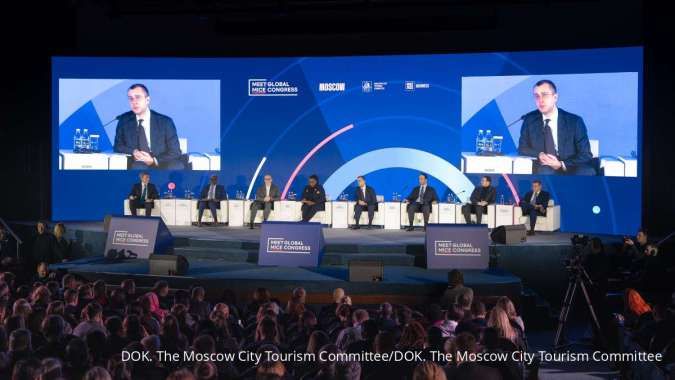
KONTAN.CO.ID - MOSCOW. Moscow has once again strengthened its position as one of the world’s leading business tourism hubs by hosting the Meet Global MICE Congress (MGMC) 2025, held on December 17–18, 2025. MGMC 2025 is the largest international MICE event, bringing together industry players from 37 BRICS countries and nations of the Global South. The congress attracted more than 2,500 participants, featured more than 130 exhibitors, and hosted 200 hosted buyers, creating direct engagement opportunities between service providers and key decision-makers. Held for the third time, MGMC 2025 carried the theme “Unity Through Open Diversity: New Opportunities for the MICE Industry,” emphasizing the importance of cross-regional collaboration amid shifting geopolitical and global economic dynamics. The theme also reflects Moscow’s strategy to position itself as an alternative MICE hub beyond traditional Western European markets.
The Moscow City Government plays an active role in supporting the development of business tourism. According to Evgeny Kozlov, Chairman of the Moscow City Tourism Committee, in 2024, one in five visitors comes to Moscow for business purposes. Moscow offers more than 2,200 hotels, nearly 23,000 food and beverage outlets, and an integrated digital travel planning system through RUSSPASS, enabling participants to plan business and leisure itineraries in just a few clicks. What sets Moscow apart, according to many MGMC participants, is its willingness to offer unconventional venues for business events, including Skolkovo Technopark, Lomonosov Cluster, Zaryadye Park, the Ostankino TV Tower, the State Historical Museum, and Khudozhestvenny Cinema. This approach underscores the city government’s role as a key facilitator of the MICE industry.
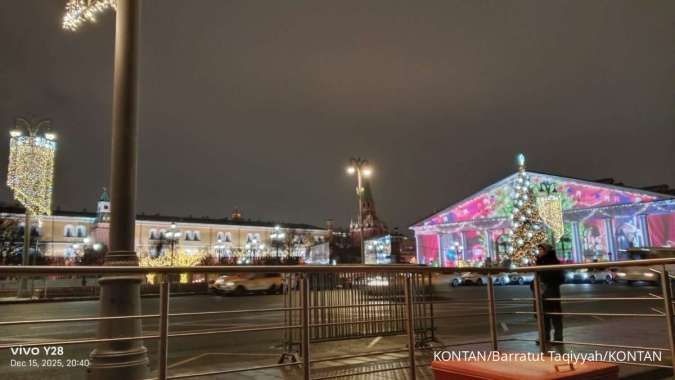
Baca Juga: Christmas Lights, World-Class Infrastructure, and Moscow’s MICE Ambitions Indonesia: Strong Potential, Still at an Early Stage
Amid this global momentum, Indonesia is beginning to position itself as a potential player, particularly following its entry into the BRICS bloc. However, according to Hosea Andreas Runkat, Chairman of the Indonesia Exhibition Companies Association (IECA), Indonesia remains in the early stages of development. “Indonesia’s entry into BRICS provides easier access. But this should not be viewed solely from a political or economic perspective. This pathway can be leveraged to strengthen tourism cooperation, especially in MICE,” Hosea told KONTAN on the sidelines of MGMC 2025. He noted that Indonesia is already strong in leisure tourism, supported by a large volume of visitors. However, when it comes to Meetings, Incentives, Conferences, and Exhibitions (MICE), the country is still “opening the path.” “When it comes to MICE, the sector is still relatively small. That’s why I’m not talking about targets yet. The focus for now is on building awareness first, and then engagement,” said Hosea, who also serves as General Manager of Sales & Marketing at the JIExpo Convention Centre and Theatre. Hosea observed that Russia’s interest in Indonesia has begun to shift. While previously driven largely by leisure tourism, over the past two to three years Russia has increasingly explored business conferences and exhibitions. Several events have already taken place in Jakarta, although on a limited scale and generally facilitated by local partners with support from embassies. “The participants are Russian business people, so it makes sense that the events are held in Jakarta. Bali is more about leisure, while MICE activities are centered in Jakarta,” he explained.
Baca Juga: Moscow Accelerates Business Tourism Drive Through Meet Global MICE Congress 2025 Structural Challenges: Visa Issues and Limited Government Support
Despite the opportunities, Hosea emphasized that Indonesia’s biggest challenge remains immigration and visa policies. He argued that visa regulations continue to be a major bottleneck in attracting international MICE players, including those from Russia. “Russian visas are very difficult. There is an e-visa now, but for business purposes there are still many challenges. The key question is: who is willing to act as the guarantor?” he said. He added that Indonesia’s relatively neutral geopolitical position amid ongoing global conflicts could actually become a strategic advantage in attracting markets that previously focused on Europe. “This is actually a big opportunity. Those who used to go to Europe are now turning to Asia. Asia is vast. China is strong, but there’s no reason Indonesia shouldn’t take part,” he said. However, Hosea stressed that these opportunities will not be fully realized without concrete government support. He pointed to the limited role of the state in promotion, incentives, and the provision of MICE infrastructure. “Almost all venues in Indonesia are built by the private sector. In other countries, many are built by the government. That’s the difference,” he noted.
Baca Juga: Indonesia Signs Free Trade Deal with Russian-led Eurasian Economic Union Government–Industry Collaboration as the Key
Hosea underlined that the success of the MICE industry in many countries is inseparable from close collaboration between the government and the private sector. Without such synergy, ambitious targets—including entering the top tier of the global MICE industry by 2030—will be difficult to achieve. “If the government doesn’t fully step in, the industry cannot move forward on its own. Targets will never be reached if everyone works separately,” he asserted.
He cited promotional support as one of the most fundamental needs. International promotion costs, he said, are too high to be borne solely by the private sector. In many countries, MICE promotion is an integral part of national tourism strategies. “Sometimes the industry asks for A, but the government delivers B. Both may be ‘rice,’ but one is nasi Padang and the other is not,” he said, illustrating the policy misalignment. Looking ahead, Hosea hopes Indonesia–Russia cooperation can be strengthened through sister city initiatives, business delegation exchanges, joint bidding, and mutual hosting of events. He also expressed openness to bringing Indonesian delegations and opening a pavilion at future MGMC editions, while inviting Russian partners to exhibitions and business forums in Indonesia. “Awareness comes first. Getting to know each other, understanding each other, recognizing mutual needs. Only after that can we talk about projects,” he concluded.